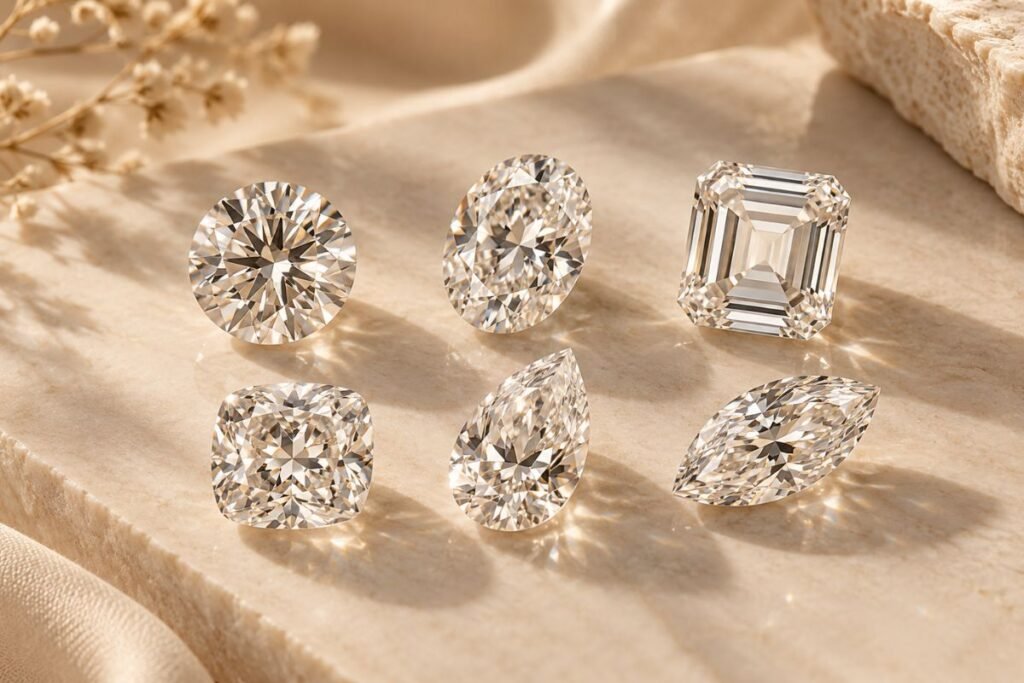
Round, oval, emerald, cushion, pear. The shape of a diamond can completely change the character of a piece of jewellery.
Some are designed to maximise sparkle. Others favour clean lines, symmetry and flashes of light. Some feel unmistakably contemporary, others have roots stretching back generations.
And while we commonly talk about diamond cuts, there is an important distinction worth understanding before choosing one.
Technically, a diamond’s shape describes its outline when viewed from above, while its cut describes the arrangement, proportions and finish of its facets, the surfaces responsible for interacting with light. The two are closely connected, but they are not quite the same thing.
Understanding both makes comparing diamonds considerably easier.
At a Glance: The Essential Diamond Shapes
- Round Brilliant: Classic symmetry and exceptional brilliance.
- Oval: An elongated brilliant style with softer curves.
- Emerald: Clean step-cut facets and a distinctive hall-of-mirrors effect.
- Cushion: Softened corners with a square or rectangular outline.
- Pear: A combination of a rounded end and elegant point.
- Marquise: Long, narrow and distinctive, with pointed ends.
- Princess: A contemporary square shape with brilliant-style faceting.
- Radiant: Geometric lines combined with lively brilliant faceting.
- Asscher: Square, architectural and step-cut.
- Heart: An unmistakably romantic shape where symmetry is particularly important.
First: What Is the Difference Between Diamond Cut and Shape?
The words are often used interchangeably, but technically they describe different characteristics.
- Shape is the silhouette of the diamond: round, oval, pear, square, rectangular or otherwise.
- Cut is how that diamond has been fashioned, including its facet arrangement, proportions, symmetry and polish and consequently how it handles light.
This distinction matters because two diamonds of exactly the same shape can look remarkably different depending on how well they have been cut.
The standard round brilliant is particularly well defined, normally featuring 57 or 58 facets. It is also currently the only diamond shape for which GIA provides an overall cut grade, ranging from Excellent to Poor. Fancy shapes such as oval, pear, emerald and cushion do not receive an equivalent overall GIA cut grade because their facet patterns and proportions vary much more widely.
Brilliant, Step and Mixed Cuts
Before looking at individual shapes, it helps to understand two of the principal approaches to faceting.
Brilliant Cuts
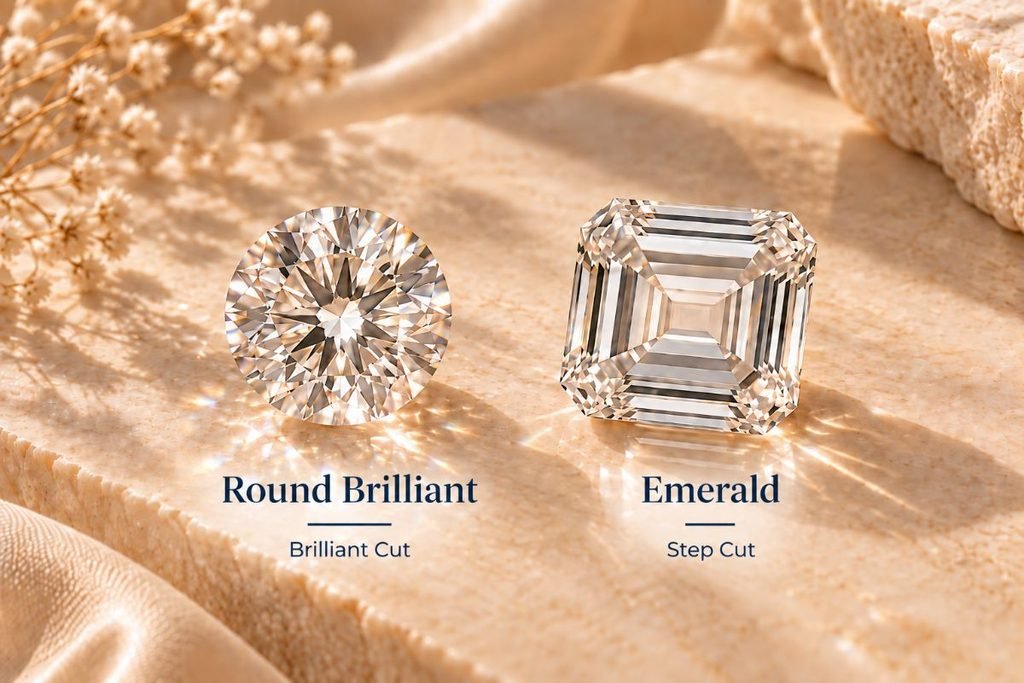
Brilliant-style diamonds use numerous triangular and kite-shaped facets arranged to reflect and disperse light. The result is the lively combination of brightness, fire and scintillation that most of us associate with a sparkling diamond.
Round brilliant, oval, pear, marquise and many princess and cushion diamonds use brilliant-style faceting.
Step Cuts
Step-cut diamonds take a different approach. Their longer, more linear facets are arranged in parallel rows, producing broad flashes of light rather than the more fragmented sparkle of a brilliant cut.
Emerald and Asscher cuts are the best-known examples.
The effect is often described as a hall of mirrors, elegant, geometric and distinctly different from the brilliance of a round stone. Because those facets are larger and more open, colour and inclusions can also be easier to see in step-cut diamonds than in brilliant cuts.
Mixed Cuts
Some diamonds combine elements of both.
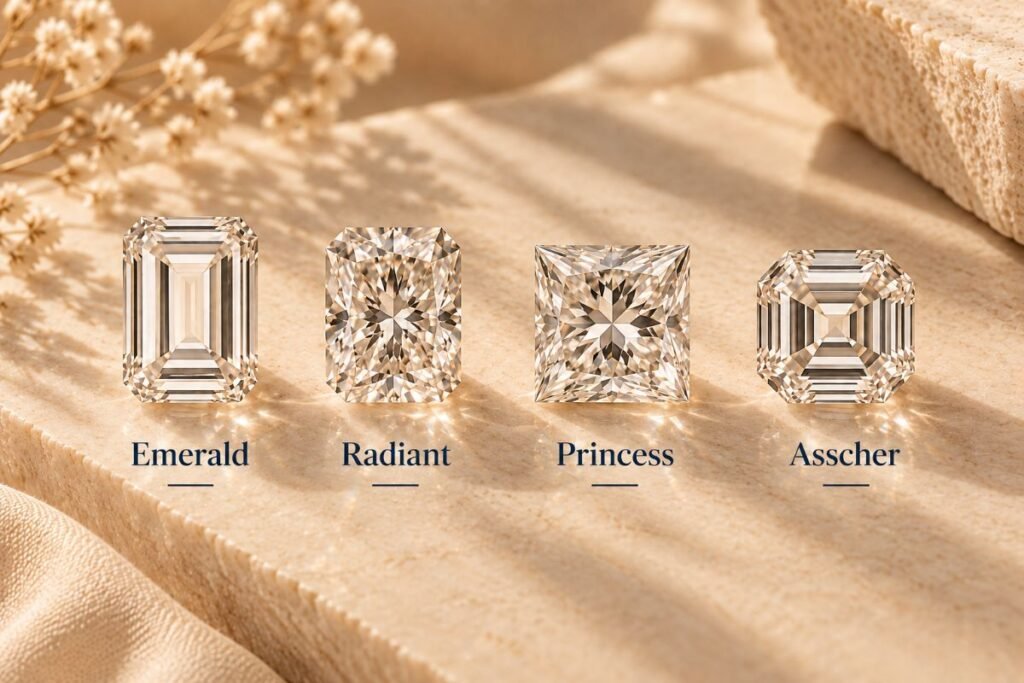
The radiant cut is a good example, pairing a square or rectangular outline and cropped corners with brilliant-style faceting designed to create significantly more sparkle than a traditional step-cut emerald.
Round Brilliant
If there is one diamond shape almost everyone recognises, it is the round brilliant.
Its characteristic 57 or 58 facets have been carefully developed to maximise the way light enters, travels through and returns from the diamond. The result is the combination of brightness, coloured flashes of fire and sparkle for which brilliant-cut diamonds are known.
Its symmetry also makes the round brilliant enormously versatile. It works just as comfortably in a simple solitaire as it does surrounded by smaller diamonds or incorporated into more elaborate jewellery.
It is the benchmark against which many other brilliant-style shapes are compared.
But even within the same round outline, cut quality matters enormously. A well-proportioned round brilliant can appear lively and balanced, while poor proportions can allow light to escape rather than return effectively to the viewer.
Oval
An oval diamond takes much of the visual character of a brilliant cut and stretches it into a softer, elongated silhouette.
Its curves give it a graceful appearance, while the greater length can create a noticeably different presence on the hand compared with a round stone of similar weight.
There is no single correct oval proportion. Some are relatively broad, others considerably more elongated. Personal preference therefore plays a large role.
One characteristic worth looking for is the bow-tie effect, a darker area running across the centre of some elongated brilliant-cut diamonds. A degree of bow-tie can occur naturally, but if it becomes overly pronounced it can distract from the appearance of the stone.
For that reason, ovals are particularly worth viewing rather than judging from dimensions alone.
Emerald
The emerald cut offers almost the opposite visual experience to the round brilliant.
Rather than trying to create maximum sparkle through numerous small facets, it uses long, parallel step-cut facets to produce broad flashes and reflections. The effect is sophisticated and architectural.
Its rectangular outline, cropped corners and large open table make the diamond’s internal character more visible too.
That means inclusions and body colour may be easier to detect than in a brilliant-style stone, so clarity and colour can deserve additional attention when comparing emerald cuts.
For someone drawn to clean geometry rather than constant sparkle, however, that openness is precisely the attraction.
Cushion
As its name suggests, the cushion cut typically combines a square or rectangular outline with softened, rounded corners.
Cushions can vary considerably, some are almost square. Others are noticeably elongated. Faceting patterns can also differ, creating anything from larger, more defined flashes of light to the finer appearance sometimes described as crushed ice.
That variety is part of the appeal, but it also means the words ‘cushion cut’ alone do not tell you exactly what the diamond will look like. Two cushion diamonds with similar measurements can still have very different personalities.
Pear
The pear shape combines a curved, rounded end with a single tapered point.
It sits somewhere visually between an oval and marquise, creating an elegant asymmetry that works particularly well when the proportions are balanced.
Symmetry is important. Viewed face-on, the curves on either side should feel balanced, the point should align properly with the centre of the rounded end, and the shoulders should flow smoothly rather than appearing uneven.
Pear-shaped brilliant diamonds can also display a bow-tie effect, so again the stone itself matters more than measurements alone.
Marquise
Few diamond shapes are as immediately recognisable as the marquise.
Long and narrow with a point at either end, it creates a particularly elongated appearance and can make the diamond appear visually substantial for its weight.
Those strong lines make symmetry especially important. The two points should align and the curves on either side should mirror one another. Any imbalance can be relatively easy to see.
Its pointed ends also need appropriate protection from the setting, as exposed points can be more vulnerable to damage.
Like ovals and pears, marquise diamonds can exhibit a bow-tie effect, making viewing the individual stone particularly worthwhile.

Princess
The princess cut brings brilliant-style sparkle into a much more angular form.
Typically square when viewed from above, its sharp corners and lively faceting give it a contemporary appearance that differs significantly from the softer lines of round, oval and cushion shapes.
Those corners are also its most vulnerable points. A well-designed setting should therefore protect them appropriately rather than leaving them unnecessarily exposed.
The princess cut can work particularly well for someone who appreciates geometric jewellery but still wants the liveliness associated with brilliant faceting.
Radiant
The radiant cut occupies an interesting middle ground.
It normally has a square or rectangular outline with cropped corners, giving it some of the clean geometry associated with an emerald cut.
Look inside, however, and the character is completely different. Radiant diamonds use brilliant-style or mixed faceting to create considerably more fragmented sparkle. That can also make them more forgiving of some inclusions than open step cuts.
So while emerald and radiant diamonds may initially share a similar outline, the way they interact with light can be dramatically different.
Asscher
An Asscher cut can initially resemble a square emerald cut.
Look more closely and its personality becomes much clearer. Its square outline, cropped corners and concentric step facets create a deep, geometric appearance that draws the eye towards the centre of the stone.
Like the emerald cut, it is known more for broad flashes and its hall-of-mirrors effect than for the busy sparkle of a brilliant stone.
The style was developed in the early 20th century and became closely associated with the geometric aesthetics of the Art Deco era.
Because its facets are large and open, clarity deserves careful consideration here too.
Heart
The heart-shaped diamond is perhaps the least subtle shape on the list and intentionally so.
Its appeal lies in its symbolism as much as its faceting. Creating a convincing heart requires careful balance between the rounded lobes, central cleft and pointed base.
Symmetry is particularly important because even small differences between the two sides can become immediately apparent.
It may not have the universality of a round or oval diamond, but for the right piece of jewellery its character is difficult to replicate with any other shape.
What Should You Look for When Choosing a Diamond Shape?
Once you move beyond the round brilliant, choosing a diamond becomes less about finding one mathematically “correct” set of proportions and more about judging the stone as a whole.
A few things are particularly worth considering.
Look at the Outline
Does the shape feel balanced?
For symmetrical shapes, check that opposite sides mirror one another appropriately. Curves should feel smooth, while points should be properly aligned.
Consider the Length-to-Width Ratio
Oval, emerald, radiant, cushion, pear and marquise diamonds can all vary from relatively broad to noticeably elongated.
Neither is automatically better. The ratio simply changes the character of the stone.
Pay Attention to Symmetry and Polish
Although GIA does not currently give fancy-shaped diamonds an overall cut grade, grading reports do assess characteristics including symmetry and polish.
Look for Bow-Ties in Elongated Brilliant Shapes
Oval, pear and marquise diamonds can exhibit darker bow-tie areas across their centres. Some are barely noticeable, others dominate the appearance.
Photographs and certificates can help, but this is one characteristic that is particularly useful to assess visually.
Think About the Setting
A diamond doesn’t exist in isolation.
Sharp corners and points may require greater protection, while different proportions can completely change how a stone works within a particular ring, pendant or pair of earrings.
Don’t Choose From the Certificate Alone
A grading report tells you important objective information. It cannot tell you which of two beautifully proportioned fancy-shaped diamonds you will prefer when you see them.
That final decision remains surprisingly personal.
Frequently Asked Questions
The Love Lux Life View

It is easy to approach diamond shopping as though there must be a single best cut but there simply isn’t.
The round brilliant remains extraordinary at what it was designed to do, turn light into brightness, fire and movement. However, not everyone wants maximum sparkle.
An emerald or Asscher can feel quieter and more architectural. An oval or pear brings softness and length. A cushion can feel romantic, while a radiant combines geometry with considerably more energy.
That is what makes diamond shapes interesting.
They don’t simply alter the outline of the stone. They change the way it behaves, the way it sits within a piece of jewellery and ultimately the way it feels to the person wearing it.
For Love Lux Life, the most compelling diamond isn’t necessarily the one following the current trend. It’s the one whose proportions, light and character still make you stop and look again.
Image note: Images in this article are for illustrative purposes and were created for Love Lux Life using generative AI.
Read more Luxury Jewellery & Watches news with Love Lux Life