A luxury watch can cost hundreds, thousands or considerably more. But when a £50 watch can tell the time perfectly well, what exactly are you paying for?
The answer is more complicated than a prestigious name on the dial.
At its simplest, a watch exists to tell the time. And if accuracy were the only measure of value, some of the most expensive mechanical watches in the world would be difficult to justify. Quartz watches are exceptionally accurate, while mechanical watches rely on an intricate system of springs, gears, escapements and balances.
And therein lies much of the appeal.
A luxury mechanical watch is less about finding the easiest way to tell the time and more about how that task is accomplished.
At a Glance: What Can Make a Luxury Watch Worth More?
- Movement: The engineering, complexity and construction behind the watch.
- Finishing and Craftsmanship: The level of assembly, finishing and specialist skill involved.
- Materials: From precious metals and ceramics to sapphire crystal and specialist dial materials.
- Precision: Testing, regulation and chronometric performance.
- Design: Proportion, originality and whether the watch is likely to age well.
- Heritage: Where a brand’s history translates into expertise and identity.
- Production: Specialist techniques and genuinely limited output.
- Serviceability: The ability to maintain and repair the watch over many years.
- Emotion: The personal significance a watch acquires for its owner.
The Movement
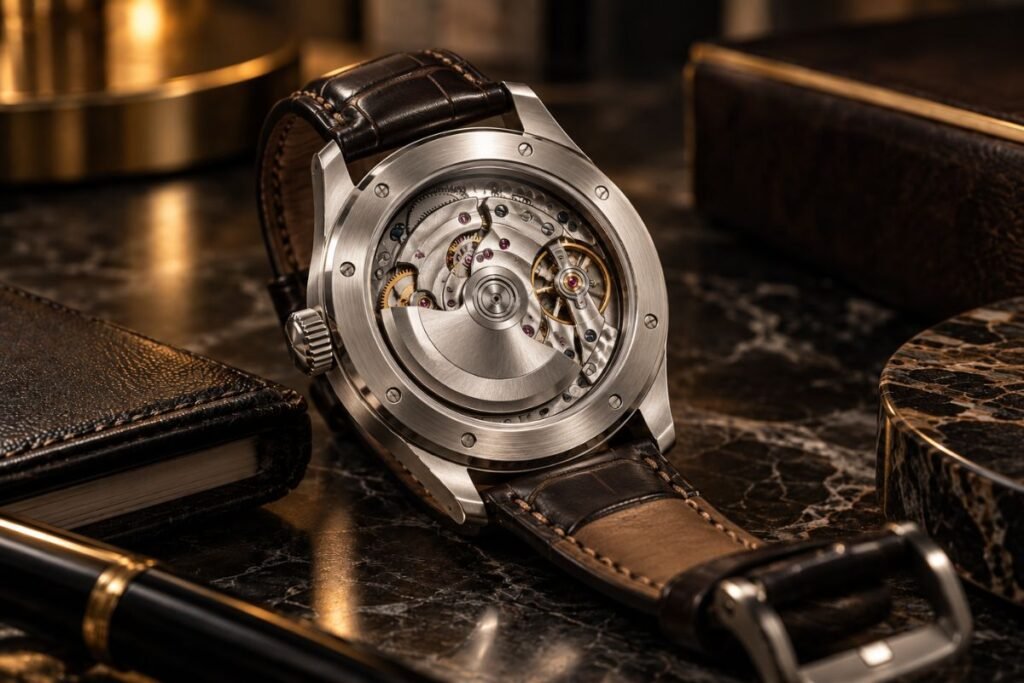
Turn over a mechanical watch with an exhibition caseback, or look through the openworked dial of a skeleton watch and the difference begins to make sense.
A mechanical movement can contain well over a hundred individual components, with considerably more required when complications such as chronographs, calendars or moon phases are added.
Energy is stored in a mainspring before passing through an elaborate sequence of gears and regulating components to move the hands. In an automatic watch, the movement of the wearer’s wrist rotates a weighted rotor, which winds that mainspring.
None of this is necessary in the modern world, that is precisely why enthusiasts appreciate it.
A mechanical movement represents a miniature piece of engineering, one that can continue performing its job for decades when properly maintained.
But an important distinction is worth making: mechanical does not automatically mean luxury.
There are excellent, affordable mechanical movements and extremely sophisticated ones costing many thousands of pounds. The architecture, type of materials, level of finishing, complexity, development and assembly all matter.
Likewise, an “in-house” movement is not automatically superior simply because a brand manufactures it itself. What matters is what has actually gone into its design and execution.
The Finishing You May Barely See
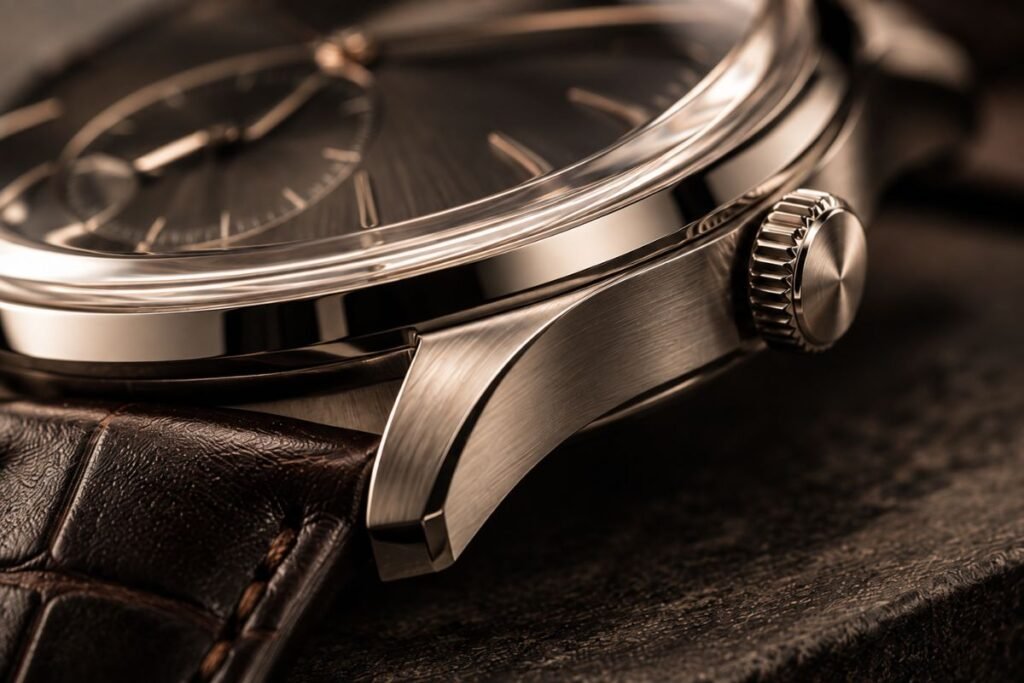
One of the clearest differences between an ordinary mechanical watch and fine watchmaking can be found in details many owners will rarely notice.
Movement components can be polished, bevelled and decorated. Screws may be finished individually. Bridges can feature carefully applied patterns. Cases may combine highly polished surfaces with sharply defined brushing.
Grand Seiko offers a particularly clear example. Its celebrated Zaratsu polishing technique is used to create distortion-free mirror surfaces and sharply defined edges, the kind of finishing that can appear deceptively simple until you understand the skill required to achieve it.
At the very highest levels of watchmaking, considerable time can be spent perfecting a component that will ultimately sit beneath the back of the watch case
There is something wonderfully irrational about that. But luxury has rarely been defined by efficiency alone.
It is the decision to finish something beautifully even when doing so is not strictly necessary that separates craftsmanship from simple production.
Materials Matter…But Not Quite as Much as You Might Think
Luxury watches frequently use materials chosen for durability, appearance or technical performance.
Cases might be produced from precious metals, titanium or specialist ceramics. Sapphire crystal is commonly used on watch faces because of its resistance to scratching. Dials can incorporate enamel, mother-of-pearl, gemstones or painstakingly applied finishes.
Yet materials alone rarely explain the price. A gold watch is not simply the value of its gold, just as a beautifully tailored suit is not simply the cost of its cloth.
The greater question is what has been done with those materials.
Precision machining, hand finishing, dial making, setting, assembly, testing and quality control can all contribute to the final piece.
Precision Still Matters
Although mechanical watches cannot generally compete with quartz technology purely on accuracy, precision remains an important part of serious watchmaking.
Independent organisations such as Switzerland’s COSC, The Official Swiss Chronometer Testing Institute test movements and watches against defined chronometric standards, giving buyers a measurable indication of performance.
But certification is only one part of the picture. A watch does not need independent certification to be beautifully made, and certification itself does not automatically make one watch more desirable than another.
As with almost everything in luxury, context matters.
Design That Survives Fashion
There is also value in something rather harder to measure: design.
Many of the most enduring watches have remained recognisable for decades because their proportions, dials and cases were strong enough to survive changing fashion.
Consider the Cartier Tank, created in 1917, or the Rolex Submariner, introduced in 1953. Their purposes and aesthetics could hardly be more different, yet both have retained remarkably recognisable design identities while evolving over generations.
Good watch design often looks simple because the difficult decisions have already been made.
The length of the hands. The shape of the indices. The depth of the dial. The width of the bezel. The relationship between the case and bracelet.
Individually, these details can seem inconsequential. Together, they determine whether a watch feels balanced or awkward.
While trends inevitably influence watchmaking, longevity tends to matter more in luxury than novelty alone.
Heritage, When It Actually Means Something
Watch brands understandably place considerable emphasis on heritage. Swiss watchmaking itself stretches back centuries, and many manufacturers draw directly upon archive designs, historic movements and generations of accumulated technical knowledge.
In some cases, that history is meaningful. Breguet, for example, traces its origins to Abraham-Louis Breguet opening his Paris workshop in 1775, with innovations from his work continuing to influence mechanical watchmaking. Elsewhere across the industry, established manufacturers draw upon archive designs, historic movements and generations of accumulated technical knowledge.
But heritage should not be confused with quality simply because a marketing campaign says so. For example, a long-established name can make an ordinary watch. A relatively young independent watchmaker can make an exceptional one.
History has value when it translates into expertise, identity and continuity, rather than simply appearing in advertising copy.
What Does ‘Swiss Made’ Really Tell You?
Few words carry as much weight on a watch dial as Swiss Made, but it is worth understanding what the designation actually means.
Swiss Made is a regulated designation. Among other requirements, a defined proportion of the manufacturing cost must be generated in Switzerland, with technical development, movement requirements, assembly and final inspection also subject to rules.
That makes Swiss Made considerably more meaningful than a simple marketing phrase.
But it does not mean that every individual component of the watch was produced entirely in Switzerland, nor does the wording on its own tell you whether a particular watch represents good value.
Think of it as useful information rather than a guarantee of greatness.
Production and Scarcity
Some watches are expensive because producing them genuinely takes time.
Complex movements require more development and assembly. Hand-finishing limits production. Gem-setting demands specialist expertise. Certain decorative crafts may be carried out by only a small number of artisans.
Small independent watchmakers can also face entirely different economics from brands producing watches in much greater volumes.
Scarcity can therefore be real. But scarcity can also be manufactured. A watch being difficult to buy does not automatically make it a better watch.
This is where separating desirability from quality becomes particularly useful.
The Ability to Last
One of the strongest arguments for a well-made mechanical watch is longevity.
Unlike most pieces of personal technology, a mechanical watch is not necessarily designed to become obsolete when the next generation arrives. It can be maintained, repaired and potentially passed from one owner to another.
That does not make ownership maintenance-free. Mechanical watches require servicing, and specialist repairs can be expensive.
Before buying, it is therefore worth considering something much less glamorous than the dial: Can this watch realistically be maintained in 10, 20 or 30 years’ time?
Strong after-sales support and access to parts can be just as important to long-term ownership as the specification you see in the showroom.
And Then There Is Emotion
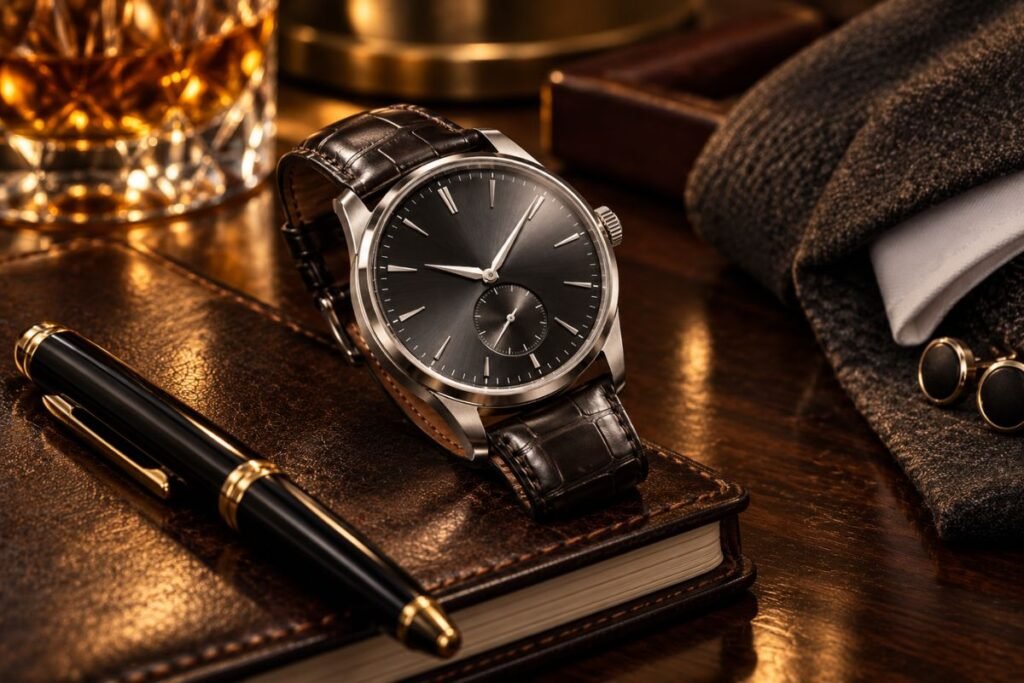
This is perhaps the part spreadsheets struggle with.
Watches often mark something. A birthday. A wedding. A promotion. A milestone. Something inherited. Something saved for. Sometimes the significance comes long after the purchase.
That emotional connection is difficult to price, but it helps explain why a mechanical object that performs a function already available on every smartphone can still matter enormously to its owner.
A luxury watch sits somewhere between engineering, design, craftsmanship and jewellery.
And perhaps that is a better way to judge it.
Frequently Asked Questions
The Love Lux Life View

A luxury watch is difficult to justify on function alone and that is rather the point.
A £20,000 watch is not automatically twenty times better than a £1,000 one, and price is no guarantee of craftsmanship.
The more interesting question is what sits behind the price: The movement, finishing, materials, design, production, serviceability and the skill involved in bringing all of those elements together.
Then there is the part that cannot easily be measured, how a watch feels, what it represents and whether you still want to wear it years after buying it.
For Love Lux Life, that is where the real value lies, not in telling the time better, but in finding a more beautiful, intricate and enduring way of doing it.
Image note: Images in this article are for illustrative purposes and were created for Love Lux Life using generative AI.
Read more Luxury Watches & Jewellery news with Love Lux Life