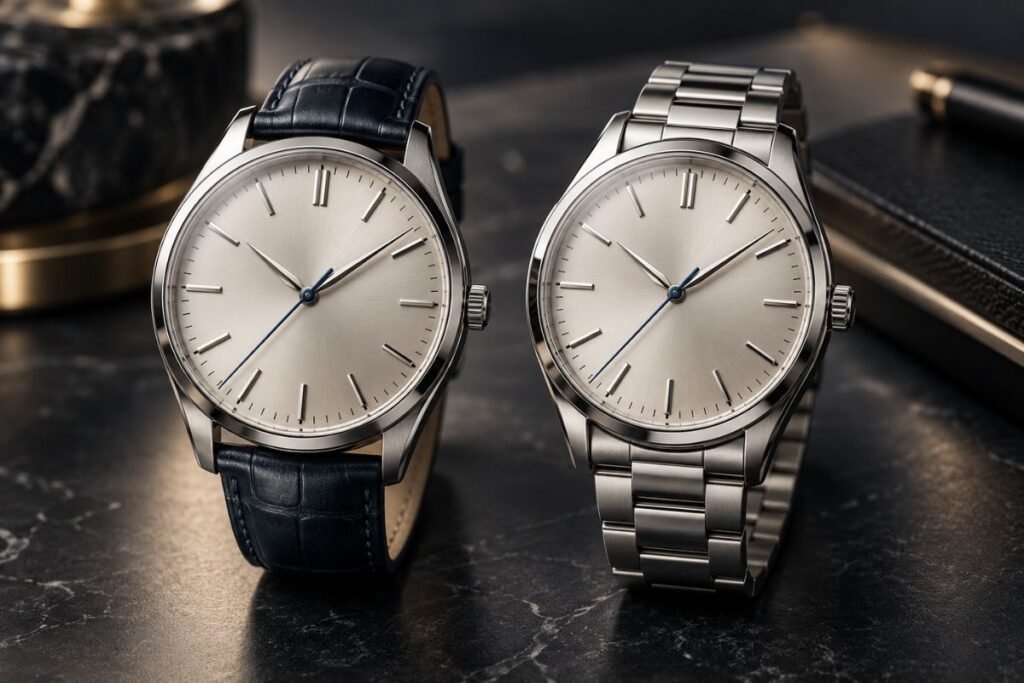
At first glance, two watches can look remarkably similar. Both may have traditional hands, a beautifully finished dial and a case made from the same materials.
What happens beneath that dial, however, can be completely different.
An automatic watch is mechanical, powered by a wound mainspring and a system of gears rather than a battery. A traditional quartz watch is usually powered by a battery, which sends an electrical current through a quartz crystal. The crystal vibrates at a highly stable frequency, helping the watch regulate time with exceptional accuracy.
That difference influences almost everything from accuracy and maintenance to how the seconds hand moves and, perhaps most importantly, how the watch feels to own.
Neither is inherently better.
The more useful question is: Which type of watch better suits what you value?
At a Glance: Automatic vs Quartz
- How they work: Automatic watches use mechanical energy; quartz watches use an electronic oscillator.
- Power: An automatic watch winds as you wear it, while most traditional quartz watches use a battery.
- Accuracy: Quartz is generally considerably more accurate.
- Movement: Automatic seconds hands usually appear to sweep more smoothly; traditional quartz seconds hands commonly move once per second.
- Maintenance: Mechanical watches require periodic servicing; quartz watches generally require less routine maintenance.
- Craftsmanship: Automatic movements often place greater emphasis on mechanical engineering and finishing.
- Convenience: Quartz can usually be left for long periods and simply continues keeping time.
- Longevity: Both can last for decades when properly maintained, although they achieve this in very different ways.
Which should you choose? That depends on whether you value precision and convenience or mechanical craftsmanship and interaction.
Automatic vs Quartz: Quick Comparison
| Automatic | Quartz | |
|---|---|---|
| Power source | Mechanical mainspring | Usually a battery |
| Battery required? | No | Usually yes |
| Accuracy | Generally less accurate | Generally more accurate |
| Seconds hand | Usually appears to sweep | Usually ticks once per second |
| Servicing | Periodic servicing recommended | Generally lower maintenance |
| Stops when unworn? | Yes, once power reserve runs out | No, while it has power |
| Needs winding? | Sometimes | No |
| Main appeal | Craftsmanship, engineering, tradition | Accuracy, convenience, reliability |
| Typical ownership cost | Usually higher | Usually lower |
What Is an Automatic Watch?
An automatic watch is a type of mechanical watch.
Rather than relying on a battery or electronic circuit, it stores energy in a tightly coiled mainspring. That energy is gradually released through a system of gears, while the escapement and balance regulate the rate at which the movement runs. The clever part is how the mainspring gets wound.
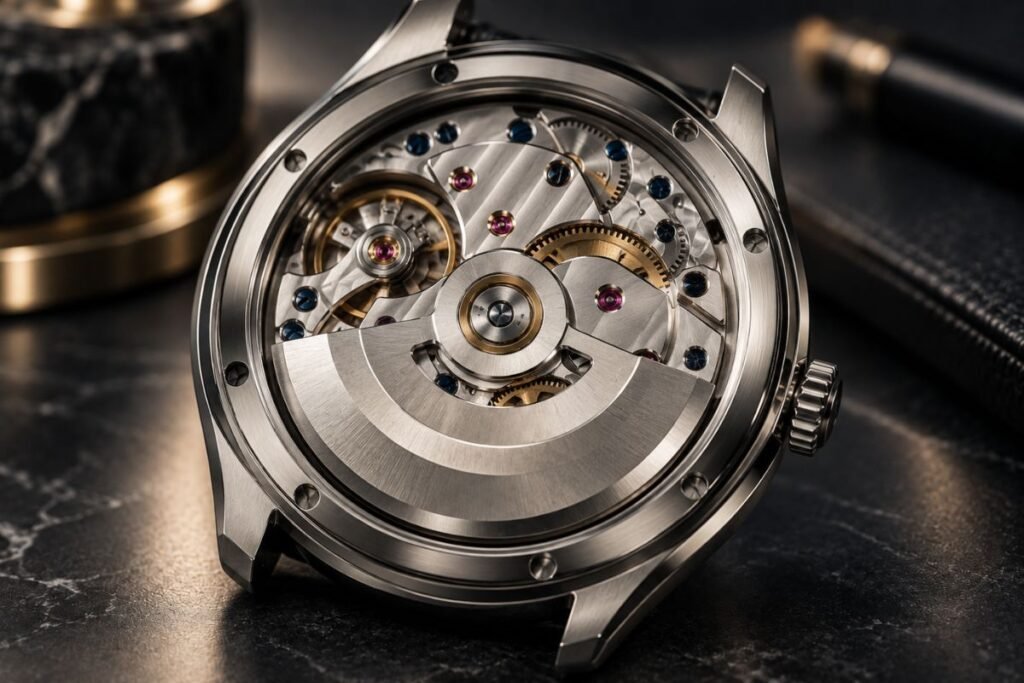
Inside an automatic watch is a weighted component called a rotor. As your wrist moves throughout the day, the rotor turns, transferring energy into the mainspring. Simply wearing the watch helps keep it running.
A mechanical movement can contain well over a hundred individual components, with the number increasing significantly when complications are added.
Take the watch off for long enough, however, and eventually the stored energy runs out and the watch stops. Put it back on, wind it and reset the time, and the watch will start working again.
If an automatic watch is left unworn for long enough, the stored energy in its mainspring will eventually run out and the watch will stop. Some owners use a watch winder which is a device that gently rotates an automatic watch to mimic the movement of the wrist and help keep it wound while it isn’t being worn. They can be particularly convenient for people who rotate between several watches or own pieces with complications that are more time-consuming to reset.
A watch winder isn’t essential for most automatic watches, however. Allowing a watch to stop when it isn’t being worn is perfectly normal, and it can simply be wound and reset when needed.
Automatic vs mechanical: are they the same?
Not quite. All automatic watches are mechanical watches, but not all mechanical watches are automatic.
A manually wound mechanical watch uses the same fundamental principles but does not contain an automatic winding rotor. Instead, the wearer periodically winds the mainspring using the crown.
So when people compare automatic and quartz watches, they are really comparing one form of mechanical watchmaking with a battery-powered quartz movement.
How Does a Quartz Watch Work?
Quartz takes an entirely different approach. The short answer, a traditional quartz watch uses a small battery to send electrical energy through a quartz crystal.
There’s more to it than simply a battery though. A technical explanation would be that when electricity is applied, the crystal oscillates at an extremely stable frequency, fun fact, commonly 32,768 times per second. An integrated circuit counts those oscillations and converts them into regular electrical impulses that ultimately move the hands.
A quartz watch is an extremely effective way of measuring time. And because the quartz crystal oscillates at such a high frequency compared with the balance inside a mechanical movement, quartz watches can achieve much greater accuracy when compared with mechanical watches.
The arrival of quartz technology transformed watchmaking. Suddenly, exceptionally precise timekeeping could be produced relatively efficiently and at scale. But quartz should not automatically be interpreted as cheap.
There are basic quartz movements designed for affordability, just as there are highly sophisticated quartz movements engineered and finished to extremely demanding standards.
Grand Seiko’s 9F movements, for example, use individually selected quartz oscillators, temperature compensation and specialised motors capable of moving substantial watch hands, an illustration of just how far high-end quartz watchmaking can go.

Which Is More Accurate?
On pure timekeeping accuracy, quartz wins comfortably.
The Federation of the Swiss Watch Industry states that a typical quartz watch can vary by less than one second per day, while commonly used mechanical movements may vary by several seconds per day. There are, of course, exceptions at both ends.
Highly regulated mechanical watches can perform extremely well, while specialised high-accuracy quartz movements can reduce annual deviation to remarkably small amounts. But the underlying point remains, if your priority is simply knowing the correct time, quartz is the more precise technology.
Mechanical accuracy is also affected by factors that most quartz owners rarely need to consider. The amount of tension remaining in the mainspring, the position in which a watch rests, temperature, magnetism and shock can all influence the rate of a mechanical movement.
To some enthusiasts, that imperfection is a disadvantage. To others, it is part of the relationship with the watch.
Why Does an Automatic Watch Appear to Sweep?
One of the easiest visual clues as to whether a watch is an automatic or a quartz, is the seconds hand.
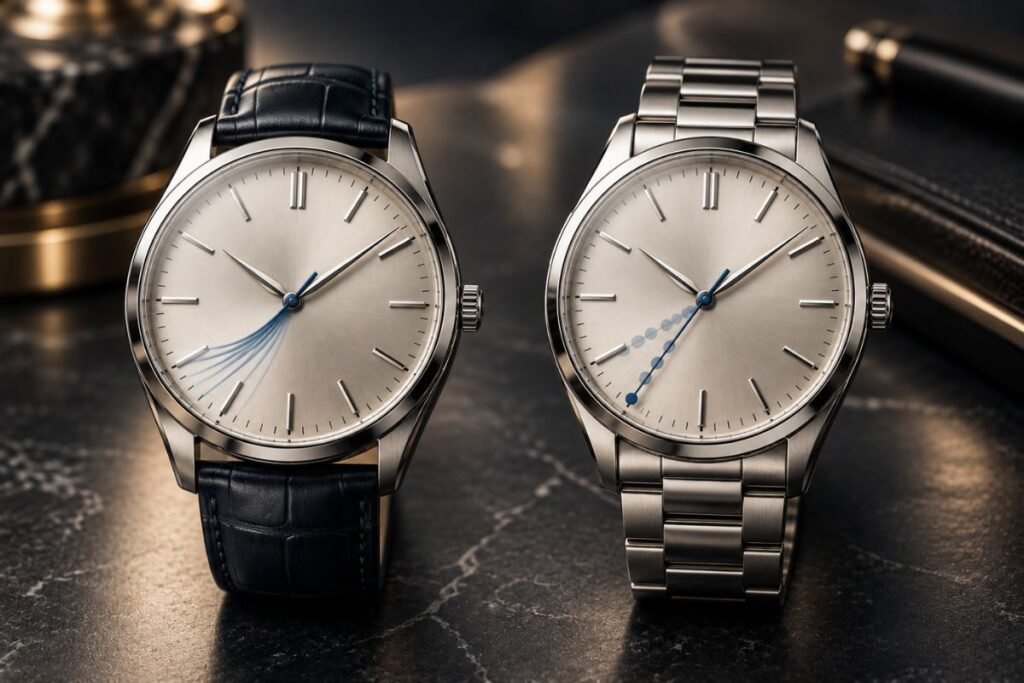
On many traditional quartz watches, the seconds hand moves forward once per second, creating the familiar tick-tick-tick motion.
On an automatic mechanical watch, the balance oscillates several times per second. The seconds hand therefore advances in a succession of much smaller movements, creating what appears to the eye to be a smoother sweep.
However, not every quartz watch ticks visibly once per second, and not every mechanical watch produces exactly the same sweeping effect.
Watchmaking is full of exceptions. But aesthetically, that smooth progression of the seconds hand has become one of the characteristics enthusiasts commonly associate with mechanical watches.
What About Battery Life and Power Reserve?
A conventional quartz watch normally draws power from a small battery that can last for several years, depending on the movement and functions involved.
For most conventional quartz watches, replacing the battery is relatively straightforward. Many jewellers can carry out a standard battery change quickly and at modest cost. More complex or highly water-resistant watches may require specialist attention, particularly where the case needs to be resealed and pressure-tested afterwards, so costs can vary.
There are also solar-powered and rechargeable quartz systems that reduce or eliminate the need for conventional battery replacement.
An automatic watch operates differently. Its mainspring stores a finite amount of energy, known as its power reserve. Wearing the watch replenishes that energy through the rotor, but if the watch remains unworn for long enough, it will eventually stop.
For someone who wears the same watch every day, that may barely be noticeable. For someone rotating between several watches, resetting an automatic watch can become part of the ownership ritual. Whether that sounds charming or inconvenient will tell you quite a lot about which technology might suit you.
Which Requires More Maintenance?
Quartz generally wins on simplicity. Most conventional quartz watches require relatively little routine attention beyond battery replacement and appropriate checks for water resistance and general condition.
An automatic movement contains numerous moving components working continuously under carefully controlled tolerances. Lubricants age. Components experience wear. Eventually, the movement will require professional servicing. How often depends on the manufacturer, movement and way the watch is used, so there is no universal servicing interval.
Servicing a complicated luxury mechanical watch can be considerably more expensive than changing the battery in a straightforward quartz model. That makes long-term ownership cost something worth considering before buying.
The purchase price is only one part of owning a watch for decades.
Is an Automatic Watch Better Made?
Not necessarily. This is where price and technology can easily become confused.
A cheap automatic watch is not automatically better made than an expensive quartz watch simply because gears and springs are involved. Quality depends on the individual movement, materials, construction, finishing and execution.
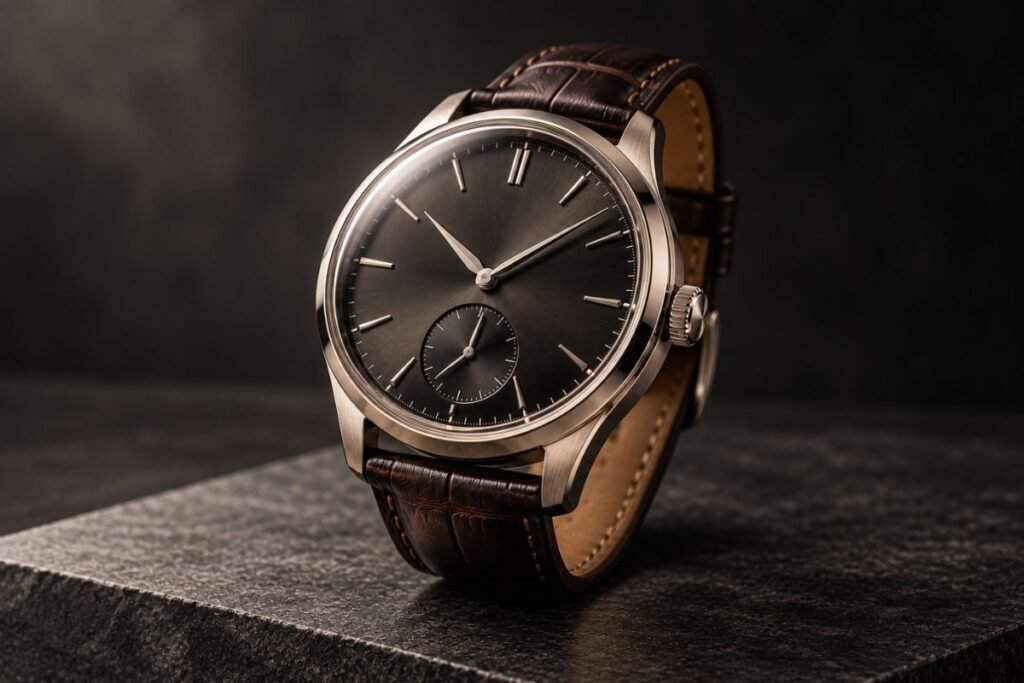
What mechanical watches offer is something different, the opportunity for craftsmanship to be expressed through the mechanism itself. An exhibition caseback can reveal decorated bridges, polished screws, bevelled edges, rotors and the movement of the balance. A skeleton or openworked dial can make the mechanics part of the design from the front.
For many enthusiasts, the movement isn’t simply what powers the watch. It is part of the reason for owning it.
Our guide to What Makes a Luxury Watch Worth the Money? looks more closely at movement construction, finishing, materials, heritage and craftsmanship.
Does Quartz Mean Less Luxury?
Absolutely not. Quartz has sometimes occupied an awkward position in the luxury watch world because inexpensive quartz movements are so widely available. But technology and quality are different questions.
There are beautifully made mechanical watches and poorly made ones. There are basic quartz watches and exceptional ones.
High-end quartz watchmaking can involve precision engineering, carefully selected crystals, temperature compensation, sophisticated electronics and extensive finishing.
There are technologies that deliberately blur the boundary. Grand Seiko’s Spring Drive, for example, stores energy in a mechanical mainspring but uses a quartz oscillator and electromagnetic braking system to regulate the movement. It combines mechanical, electrical and electromagnetic energy rather than fitting neatly into either traditional category.
Watchmaking is considerably more interesting than simply: Mechanical = luxury. Quartz = inexpensive.
What Does Each Feel Like to Own?
This may be the biggest difference of all.
Quartz tends to ask very little of its owner. Pick it up, put it on and, assuming the battery has charge, the time should still be there. There is something enormously appealing about that precision and reliability.
An automatic watch is more interactive. It responds to movement. It may need winding. If it stops, you reset it. Its accuracy can vary slightly depending on how it is worn and stored.
None of those things makes it objectively better but they create a different relationship between owner and object. It is somewhat ironic that the less technologically efficient solution can feel more engaging.
Automatic vs Quartz: Which Should You Choose?
Choose quartz if you primarily value:
- Accuracy: Quartz is generally significantly more precise.
- Convenience: Pick it up and it is usually ready to wear.
- Lower maintenance: Fewer moving mechanical components generally mean less specialist servicing.
- Practicality: Particularly for a watch that needs to be dependable without much thought.
Choose automatic if you primarily value:
- Mechanical engineering: The movement itself becomes part of the appeal.
- Craftsmanship: Particularly in watches where the movement is highly finished.
- Interaction: Winding, setting and observing the movement can become part of ownership.
- Tradition: Mechanical watchmaking carries centuries of accumulated knowledge and technique.
- Character: For some owners, tiny variations in performance make the watch feel more like a mechanical object than an electronic instrument.
Neither list determines which watch you should buy. It simply helps identify what you’re actually paying for, and what you personally value.
The Love Lux Life View

If the purpose of a watch were simply to tell the time as accurately and conveniently as possible, quartz would make an extraordinarily persuasive case.
But luxury watches have never really been about efficiency alone.
An automatic watch asks its owner to appreciate what is happening beneath the dial. A mainspring storing energy, gears transferring it and a balance oscillating thousands of times each hour, all to perform a task quartz technology can accomplish more easily.
Quartz, meanwhile, deserves more respect than the assumption that it is simply the cheaper alternative. At its best, it represents extraordinary precision and its own form of sophisticated watchmaking.
So the better question isn’t automatic or quartz? It is, what do you want your watch to give you?
For some, the answer will be absolute precision. For others, it will be the quiet fascination of a tiny mechanical machine living on the wrist.
And we believe that there is room for both.
Image note: Images in this article are for illustrative purposes and were created for Love Lux Life using generative AI.
Read more Luxury Watches & Jewellery news with Love Lux Life