There is usually a moment when you realise you have arrived somewhere exceptional.
It may happen before you have even reached your room. Someone greets you warmly without the welcome feeling rehearsed. Your luggage is taken care of without becoming a production. Check-in happens quickly, perhaps over a drink or from the comfort of a chair rather than across a desk.
Nothing feels hurried, and very little feels difficult.
Luxury hotels are often associated with the obvious things: beautiful suites, marble bathrooms, destination restaurants, swimming pools, spas and spectacular views. All of those can contribute to an extraordinary stay, but none of them, individually, is what makes a hotel truly luxurious.
The difference tends to reveal itself more gradually, in the way the hotel makes you feel while you are there.
At a Glance: What Makes a Hotel Truly Luxurious?
- Arrival: A welcome that feels seamless from the moment you reach the hotel.
- Service: Thoughtful attention that anticipates rather than simply responds.
- Sleep & Comfort: An exceptional bed, quiet room and an environment designed around rest.
- Design: Beautiful spaces that work just as well as they photograph.
- Privacy: The freedom to retreat without feeling isolated.
- Sense of Place: A hotel that could not simply be lifted and recreated somewhere else.
- Food & Drink: Dining that genuinely contributes to the stay.
- Wellbeing: Comfort and restoration extending far beyond the spa.
- Personalisation: Recognition that feels natural rather than scripted.
- Ease & Consistency: An experience in which the details simply work, time after time.
Luxury Is More Than a Five-Star Rating
Five stars can tell you plenty about a hotel, but they cannot tell you everything.
Facilities matter. So do service standards, cleanliness, comfort and the quality of the accommodation. Yet some of the most memorable hotels in the world are not memorable because they contain the longest list of amenities.
A grand resort might offer several restaurants, an enormous spa and suites stretching across hundreds of square metres. A much smaller hotel might have twenty rooms, one excellent restaurant and very little else. Either can feel exceptionally luxurious.
What matters is the quality of the experience as a whole. Whether the hotel possesses character, whether its surroundings have been considered, whether service is consistent and whether what is offered feels appropriate to the property rather than simply added to meet expectations.
That thinking is reflected in the way the MICHELIN Guide now assesses outstanding hotels. Its criteria extend beyond facilities to architecture and design, character, quality and consistency of service, value, and the way a hotel contributes to its particular setting.
A luxury hotel is not simply somewhere that has accumulated enough expensive things. It is somewhere where those things make sense together.
The Experience Begins Before You Reach the Room
First impressions in hospitality are unusually powerful.
By the time a guest reaches a hotel they may already have spent hours travelling. There may have been traffic, airport queues, delays, unfamiliar roads or simply the tiredness that arrives at the end of a long journey. An exceptional hotel seems to understand that.
The entrance is easy to navigate. Someone is there when you arrive. Luggage quietly disappears in the right direction. Reception feels welcoming rather than administrative, and you are not left wondering what happens next.
None of this needs to be theatrical. In fact, the most convincing luxury arrivals often feel remarkably understated. The journey simply seems to end, and the stay begins.
That transition matters because it establishes something the best hotels maintain throughout the experience: the sense that somebody else has thought about the details before you have had to.
Exceptional Service Is About Anticipation
Perhaps the clearest difference between an expensive hotel and a genuinely luxurious one is service. Good service responds efficiently when something is requested. Exceptional service pays enough attention that the request is sometimes unnecessary.
A member of staff might notice that you are heading outside and mention that rain is expected. At breakfast, yesterday’s coffee order is remembered. Housekeeping notices that you preferred the additional pillows and leaves them in place the following evening.
It might be someone offering to arrange a car before you have begun working out how to get somewhere, or remembering your name without repeating it so often that the interaction starts to feel scripted.
These are small moments, but together they create the impression that the hotel is paying attention.
The difficult part is balance. There is a fine line between attentive service and intrusive service, and the best hotels seem to understand when to appear and, just as importantly, when to disappear.
Forbes Travel Guide places particular weight on service within its luxury hotel assessments, judging the guest experience across hundreds of standards and multiple touchpoints from reservation through to departure.
The best service rarely feels like a performance. It simply makes everything easier.
The real luxury lies in the feeling that everything has been considered, so you don’t have to consider very much at all.
Love Lux Life
The Bedroom Still Has One Fundamental Job
Hotel rooms have become increasingly elaborate. There may be book-matched stone bathrooms, dressing rooms, carefully curated minibars, automated curtains, enormous televisions and terraces overlooking extraordinary scenery.
But underneath all of that sits a much simpler question: Can you sleep exceptionally well?
A beautiful room quickly loses some of its appeal if the mattress is uncomfortable, light leaks around the curtains or you can hear every conversation taking place in the corridor.
Comfort is less exciting to photograph than a sculptural bathtub, but it is often far more important to the experience.
The mattress and bedding matter, but so do temperature, acoustics, blackout, ventilation and lighting. Even the ability to switch everything off from the bed without conducting a small investigation of the room’s controls can make a difference.
Hilton’s 2026 UK travel research found that 91% of British travellers regarded a comfortable bed as their most important end-of-day essential while travelling.
It is a useful reminder that some of hospitality’s most valuable luxuries remain surprisingly simple. A quiet room, a comfortable bed and waking up genuinely rested.
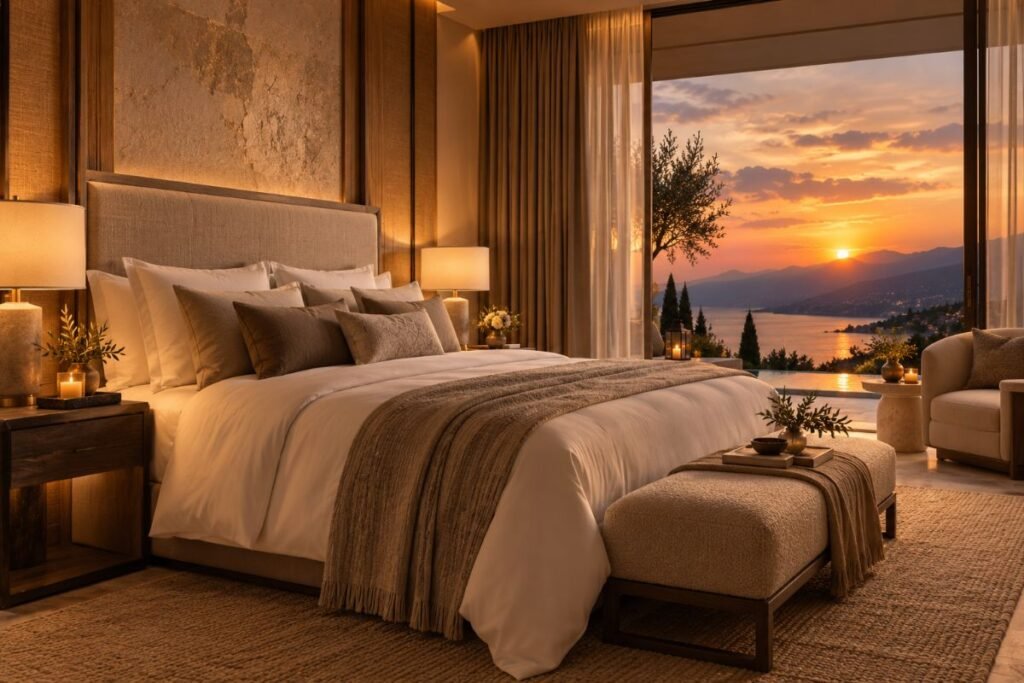
Design Should Create a Feeling, Not Just a Photograph
Some hotels are extraordinarily photogenic. That does not necessarily mean they are enjoyable to stay in.
Great hotel design has to succeed twice, first when you see it, and again when you begin using it.
There is the immediate impression of architecture, artwork, materials, lighting and furniture. Then, after an hour or two, different details begin to matter.
Are the plug sockets where you naturally need them? Is there somewhere sensible to open a suitcase without blocking half the room? Does the bathroom lighting actually work when you are getting ready? Can two people move around comfortably without negotiating the space?
Even the way a room changes after dark matters. A bedroom flooded with beautiful daylight can feel entirely different once the curtains close and the artificial lighting takes over.
The best interiors anticipate both versions.
Design should create atmosphere, certainly, but it should also make the room easier and more pleasurable to inhabit. A luxury hotel should never require guests to compromise comfort in the name of aesthetics.
The Best Hotels Know Exactly Where They Are
One of the most compelling qualities a hotel can possess is a genuine sense of place. You should, in some way, know where you are.
That does not mean covering every room in obvious local references. Often the strongest connection is considerably subtler.
It might be stone quarried nearby, furniture made by local craftspeople or menus built around ingredients from the surrounding landscape. Perhaps the original building has been restored rather than erased, or the architecture has been designed specifically around a mountain, coastline or city view.
Staff matter too. There is a difference between being handed a generic list of attractions and speaking to someone who genuinely understands the place beyond the hotel doors.
A truly luxurious hotel should not make its surroundings irrelevant. At its best, it makes them more interesting.
Privacy Can Matter More Than Space
The largest suite is not automatically the most luxurious.
Sometimes privacy matters more than square footage.
It might come from the way terraces have been positioned so that neighbouring rooms cannot see into them, or from a restaurant with enough space between tables for conversations to remain private.
In a city hotel, it may be a discreet entrance or excellent sound insulation. At a resort, it could be a pool designed so that guests never feel as though they are competing for personal space.
Privacy is not the same as isolation.
The best hotels allow guests to move easily between the two states, becoming part of the atmosphere when they want to and retreating from it when they do not.
There is a particular kind of luxury in sitting on a terrace, beside a pool or in a quiet corner of a hotel and briefly feeling as though the place belongs entirely to you.
Food and Drink Should Feel Part of the Stay
A luxury hotel does not necessarily need a celebrity chef or several restaurants competing for attention. It does, however, need to understand that food and drink form part of the memory of a stay.
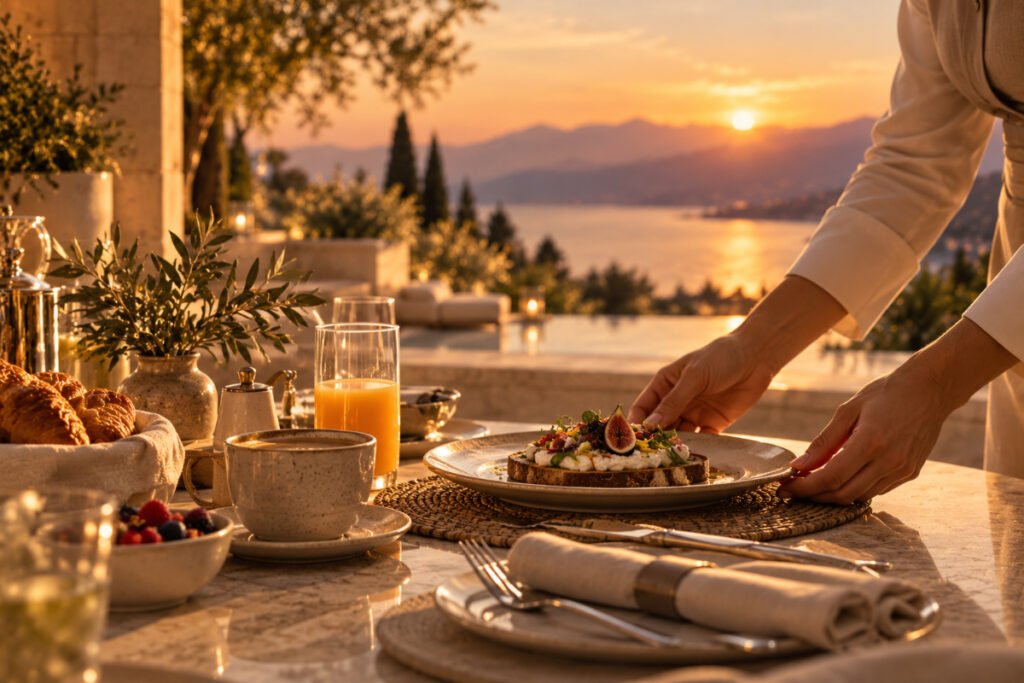
Breakfast is particularly revealing. After all, it is one of the few hotel experiences guests may repeat every day. Excellent coffee arriving promptly, properly cooked food, good ingredients and service that is attentive without being overbearing can set the tone for everything that follows.
The same principle applies later in the day. Room service should still feel appealing when you arrive late. The bar should have enough atmosphere that you want to stay for another drink. If there is a destination restaurant, it should feel like part of the hotel’s personality rather than a separate business sharing the same address.
Great hotel dining does not need to be extravagant at every turn. It needs to make you glad you stayed in.
Wellbeing Begins Long Before the Spa
A beautiful spa can be an extraordinary part of a hotel. But it is not where wellbeing begins.
Wellbeing starts with whether you sleep properly. It is affected by natural light, noise, temperature, air quality and whether the hotel provides enough space to slow down.
It may be a morning swim before breakfast, a quiet garden, somewhere inviting to walk or a gym that feels like a space somebody actually considered rather than equipment fitted into whichever room happened to be left over.
Food plays a part too, as does the simple ability to rest without an itinerary demanding attention.
The best wellness experiences do not feel bolted onto a hotel. They run quietly through it.
A spa is an amenity. Feeling noticeably better when you leave than when you arrived is something more valuable.
Technology Should Make the Hotel Simpler
Technology in hotels can be impressive. It can also be infuriating.
A touchscreen capable of controlling lighting, curtains, temperature, television and music sounds sophisticated until you find yourself standing beside it at midnight simply trying to switch off one lamp.
The purpose of hotel technology should be to remove effort, not create another layer of it.
Digital check-in can save time. Messaging the hotel can make a quick request easier. Thoughtful lighting controls can transform a room, and automatic curtains are wonderfully indulgent when they work intuitively.
The guest, however, should never feel they need a tutorial.
The smartest technology in a luxury hotel often sits quietly behind the experience. It does what it needs to do without demanding attention, leaving the human side of hospitality to remain exactly that, human.
Personalisation Should Never Feel Scripted
Personalisation has become one of hospitality’s favourite words.
Done well, it can turn a very good stay into one that feels genuinely individual. Done badly, it is immediately noticeable.
There is a difference between recognition and performance. Using someone’s name in every conversation is not necessarily personal service. Remembering that they prefer tea rather than coffee might be.
Real personalisation tends to come from observation. A returning guest’s preferred room can be noted. The table someone particularly liked can be offered again. A family travelling with small children might appreciate a restaurant booking that fits their evening rather than the hotel’s usual schedule.
None of these gestures is particularly dramatic. That is partly why they work.
Technology may increasingly help hotels remember preferences, but information alone is not hospitality. Human judgement determines when that information will improve the stay and when it is better left quietly in the background.
Luxury Does Not Have One Look
Luxury hospitality was once closely associated with formality. Grand entrances, white gloves, heavy curtains, polished silver and elaborate rituals all formed part of a recognisable visual language.
That version of luxury still has its place. In the right hotel, it can be glorious. But it is no longer the only version.
A barefoot resort reached by boat can be luxurious. So can a Georgian country house, a contemporary city hotel, a converted farmhouse or a lodge deep within a landscape where there is almost nothing else around.
The MICHELIN Guide’s hotel selection illustrates that breadth particularly well. Properties of very different sizes, styles and price points can earn its Key distinctions, rather than the award being reserved exclusively for conventional grand hotels.
The common thread is not formality. It is care, individuality and an understanding of what the hotel is trying to be.
Consistency Is Where Luxury Becomes Difficult
Almost any hotel can create one excellent moment. The real test is repeating it.
The room can be immaculate when you arrive, but what happens on the third day? Breakfast can be exceptional when the restaurant is quiet, but does the same standard remain when every table is occupied on Sunday morning?
One member of staff may deliver extraordinary service. The question is whether the experience changes when somebody else takes over.
Guests encounter a hotel through dozens of small moments; the booking, arrival, housekeeping, breakfast, the bar, concierge, spa, room service, departure and everything in between.
That is why consistency matters so much.
Leading hotel assessment systems explicitly consider it. Both MICHELIN and Forbes include consistency across the guest experience within the way they evaluate outstanding hospitality.
Luxury becomes convincing when excellence no longer feels dependent on luck.
Perhaps the Real Luxury Is Ease
The most successful hotels have an interesting ability to make complicated things seem remarkably simple.
You do not spend the stay wondering where to leave the car, whether somebody remembered the restaurant reservation or why the room is still too warm. You do not have to chase, repeat yourself or constantly make small decisions that somebody else could reasonably have anticipated.
Things simply happen when they should. This is easy to underestimate because effortless hospitality does not necessarily produce the most dramatic photographs.
But when everything works, the room, service, food, atmosphere, privacy and countless small details around them, something shifts.
You stop managing the stay. You begin enjoying it, and perhaps that is one of the clearest definitions of luxury hospitality.
Frequently Asked Questions
The Love Lux Life View

A truly luxurious hotel does not need to impress you at every opportunity. Often, the opposite is true.
The room is beautiful, but comfortable enough that you stop thinking about it. Service is attentive without constantly interrupting the experience. Technology is sophisticated but intuitive, the food is memorable and the bed is genuinely difficult to leave.
Most importantly, the small things you would usually need to organise seem to have been considered already.
A spectacular view, extraordinary suite or beautiful spa can make a hotel memorable. But for Love Lux Life, the real luxury lies in something harder to photograph: The feeling that everything has been considered, so you don’t have to consider very much at all.
That is when a hotel stops being somewhere you stayed. It becomes somewhere you want to return to.
Image note: Images in this article are for illustrative purposes and were created for Love Lux Life using generative AI.
Read more Luxury Lifestyle news with Love Lux Life