Luxury property is easy to recognise in a listing. There are the familiar signals:
- Generous square footage
- Expensive finishes
- Landscaped gardens
- Impressive kitchens
- Perhaps a swimming pool
- Cinema room
- Or carefully concealed wine cellar.
But none of those things, individually, makes a home truly luxurious.
A property can be extraordinarily expensive and still feel poorly considered. Equally, a home can be comparatively restrained yet possess something much harder to manufacture:
- Exceptional architecture
- Beautiful proportions
- Privacy
- Natural light
- Craftsmanship
- A genuine sense of place.
At its best, luxury property isn’t simply about having more. It is about living better.
At a Glance: What Makes a Property Truly Luxurious?
- Location: Somewhere desirable, convenient or genuinely difficult to replicate.
- Architecture: Considered design, proportion and a clear relationship between spaces.
- Space: Not simply more square footage, but space used intelligently.
- Natural Light & Views: Qualities that can transform how a home feels throughout the day.
- Materials & Craftsmanship: Quality you can see, touch and continue to appreciate over time.
- Privacy: The ability to retreat from the outside world without feeling disconnected from it.
- Comfort & Wellbeing: Temperature, acoustics, air quality and spaces that support how people actually live.
- Technology: Useful systems that make life easier without becoming the focus of the home.
- Outdoor Space: Gardens, terraces and landscapes that feel like an extension of the architecture.
- Rarity & Provenance: Characteristics that cannot simply be ordered from a specification sheet.
- Ease: Perhaps the quietest luxury of all, a home that removes friction from everyday life.
A High Price Doesn’t Automatically Make a Luxury Home
There is no universal price at which a property suddenly becomes luxurious. Property value is local.
What constitutes an exceptional home in Cheshire will differ from prime central London, just as London differs from Monaco, the French Riviera or Manhattan.
Even the term prime property is generally defined relative to its individual market rather than by a single international price threshold. Knight Frank, for example, defines prime residential property as the most desirable and expensive part of a particular market, generally its top 5% by value.
That distinction matters. Price can tell us something about scarcity and demand. It doesn’t necessarily tell us whether a home has been designed well.
Location: The Luxury You Cannot Retrofit
Almost everything inside a property can eventually be changed. The kitchen can be replaced. Bathrooms can be remodelled. Technology can be upgraded. Interior design can be reconsidered entirely.
The location cannot.
That is why one of the strongest markers of genuinely exceptional property remains something remarkably simple: where it is located.
It might mean walking distance to the centre of a sought-after village. A secluded country position without complete isolation. Direct water frontage. Uninterrupted countryside. A particular London square. Proximity to exceptional schools, restaurants or transport connections.
Sometimes it is the view, sometimes it is the silence. Sometimes it is the fact that another property simply cannot be built in quite the same place.
That scarcity is difficult to manufacture and increasingly important at the top of the residential market. Current luxury residential research similarly points towards exceptional settings, mature landscapes, views and genuine sense of place as attributes that remain difficult to replicate.
Architecture Before Specification
A beautifully designed house can feel luxurious before you have noticed a single piece of furniture. It comes from proportion.
Ceiling height. Window placement. Sightlines. The relationship between one room and another. How a hallway opens into a principal living space. Whether the architecture guides you naturally through the home.
Good architecture can also make comparatively modest spaces feel generous. Poor architecture can make very large ones feel awkward. This is why square footage alone is a surprisingly crude measure of luxury.
A vast house containing dark corridors, compromised rooms and unnecessary circulation space may be less pleasurable to inhabit than a smaller home in which every metre has been properly considered.
The most successful properties tend to make space feel intentional rather than simply abundant.
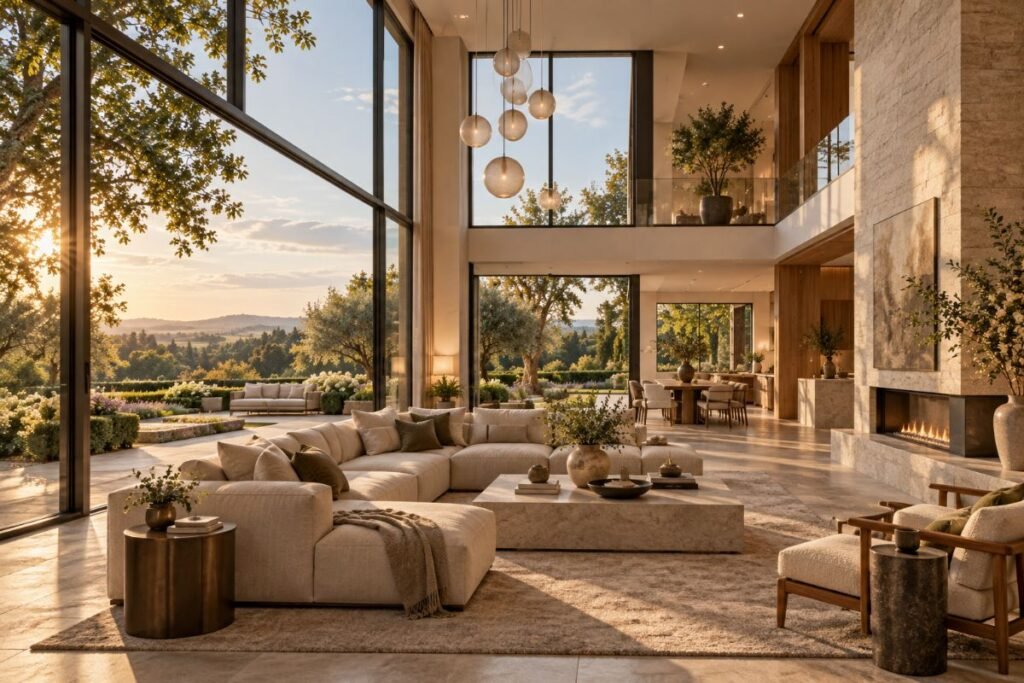
Space: But in the Right Places
Luxury does often mean having more room. But the important question is where that room has been given.
- A generous kitchen in which several people can cook without colliding.
- A principal bedroom with enough breathing space around the furniture.
- A utility room positioned where it is genuinely useful.
- Storage where belongings naturally accumulate.
- A home office that feels designed to work in rather than squeezed into whatever space remained.
- Guest accommodation that gives visitors some independence.
The luxury is not necessarily the number on the floorplan. It is having enough space where life actually happens.
Natural Light and the Power of a View
There are few upgrades more effective than something that cannot be switched on.
Natural light changes a property. It alters colour, emphasises materials, changes the character of a room throughout the day and can create a sense of generosity even where dimensions are relatively restrained.
Views do something similar. A kitchen overlooking an established garden, a bedroom facing open countryside or a city apartment positioned above its surroundings can give a property an identity that no amount of interior decoration can replicate.
Architectural guidance and wellbeing research consistently recognise daylight and visual connections with outdoor space as important elements of successful residential environments.
The best luxury homes don’t simply contain impressive interiors. They understand what exists outside the windows too.
Materials That Get Better the Closer You Look
Luxury materials do not necessarily need to announce themselves. Often, the most convincing ones do the opposite.
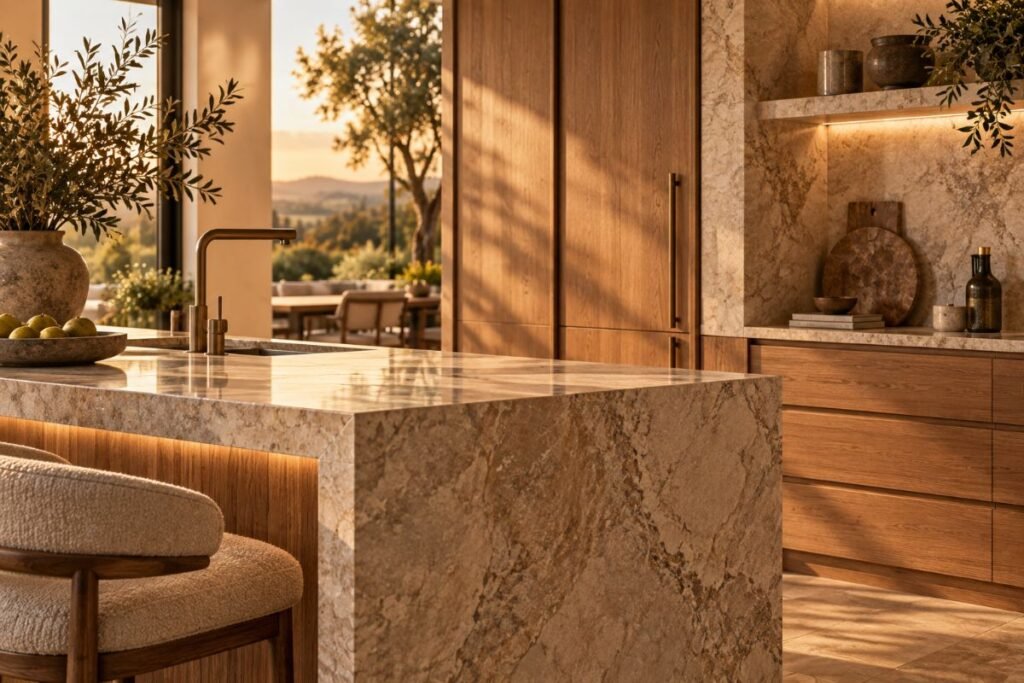
Natural stone whose pattern has been carefully considered across adjoining slabs. Timber joinery where grain, proportion and junctions have been thought through. Solid handles with a reassuring weight. Cabinetry that closes perfectly. Floors that continue cleanly between spaces.
These details become more noticeable the longer you spend in a property. That is an important distinction between expensive specification and genuine craftsmanship.
It is relatively easy to choose costly products from a brochure. It is considerably harder to ensure that every detail works together. Material quality matters.
But, much like a luxury watch, the more interesting question is often: What has been done with those materials?
Privacy Is Becoming Increasingly Valuable
Privacy is one of the least photogenic luxuries. It rarely makes the hero image of a property listing, yet it can fundamentally change how a home feels.
- At a country property, it might mean mature planting, considered boundaries and enough distance from neighbouring homes.
- In an apartment building, it could mean discreet entrances, controlled access, secure underground parking, private lifts or thoughtful acoustic separation.
- It may simply mean being able to sit in your garden without feeling overlooked.
The strongest luxury homes manage an interesting balance, privacy without isolation.
They create a sense of retreat while still allowing convenient access to everything outside it. Privacy continues to feature prominently in current prime residential development and serviced-residence propositions.
Comfort Is a Form of Luxury Too
Some of the most valuable elements of a home are the ones you stop noticing when they work properly.
- The temperature remains comfortable.
- You cannot hear every movement elsewhere in the building.
- Bedrooms are genuinely dark at night.
- Ventilation works.
- There are no cold spots.
- The rooms people spend the most time in receive good natural light.
These aren’t particularly glamorous specifications. But together they determine whether an impressive building is actually an exceptional place to live.
There has also been a wider shift in premium residential design towards wellbeing as part of the fabric of a property, rather than something represented solely by a gym or spa. Recent luxury residential research describes wellness increasingly as infrastructure rather than just an amenity.
That makes sense. A wellness suite is impressive. A home that helps you sleep well every night may be considerably more valuable.
Technology Should Disappear Into the Background
Luxury homes increasingly contain sophisticated technology. Lighting scenes. Heating and cooling controls. Security. Audio. Blinds. EV charging. Energy management. Access systems.
But there is an important difference between a technologically advanced house and one that feels like a showroom for technology. The best systems simplify.
Lights behave intuitively. Rooms reach the temperature you want without constant intervention. Security works without making the property feel fortified. Music follows you without a stack of equipment dominating the room.
Technology should remove friction. It shouldn’t create another thing to manage.
And because technology dates far more quickly than architecture, the ability to upgrade systems without fundamentally disrupting the home is increasingly valuable too.
Outdoor Space Should Feel Like Part of the Property
An exceptional garden isn’t simply land attached to a house. It should feel connected to it.
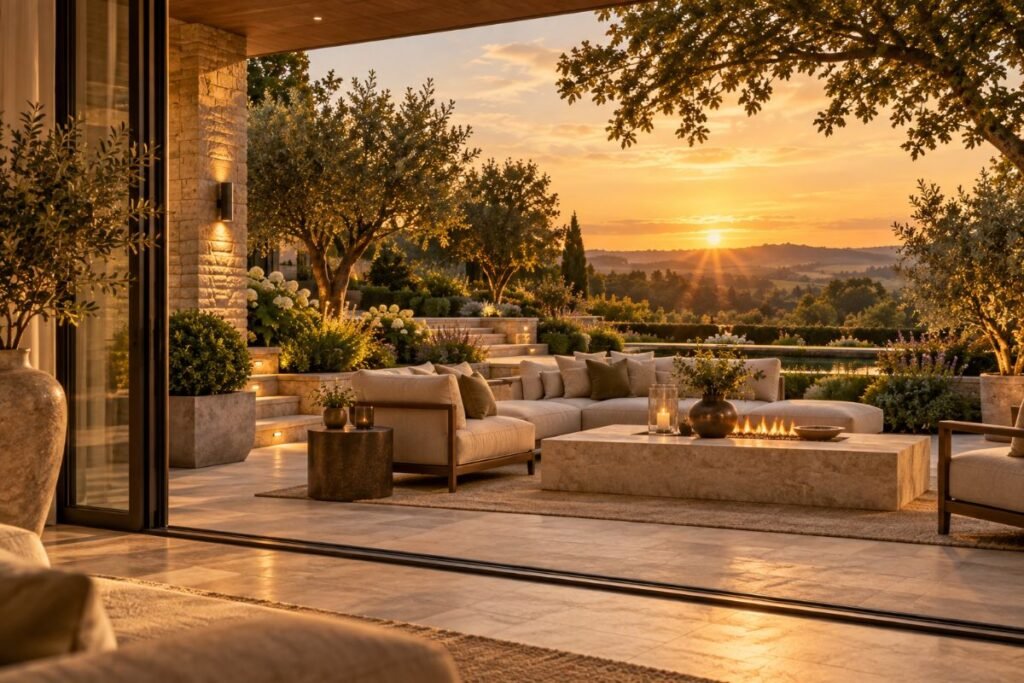
That might mean a terrace positioned precisely where the evening sun falls, planting that frames a view from inside, a kitchen opening naturally onto an entertaining space or mature landscaping that gives the house privacy throughout the year.
In warmer climates, architecture may dissolve almost completely between indoors and out.
In Britain, the relationship can be subtler, but no less important. Covered terraces, garden rooms, outdoor kitchens, courtyards, fireplaces and carefully positioned seating areas can extend how much of the property is genuinely usable.
A luxury garden isn’t necessarily the largest one. It is the one you actually want to spend time in.
Do Luxury Homes Need Pools, Gyms and Cinema Rooms?
No. They can be wonderful additions, but they are not what makes a home luxurious in their own right.
A swimming pool, private gym, cinema room, wine cellar or spa can add real value when it suits the property and the way its owners live. But these features are most successful when they feel properly integrated into the home rather than included simply because they appear on a luxury specification list.
A beautifully designed library used every evening may provide more value to its owner than a cinema room opened twice a year.
A modest swimming pool positioned to connect naturally with the house and garden may feel far more luxurious than an oversized leisure suite hidden away in a basement.
The same applies to gyms, games rooms, bars and wellness spaces. The feature itself is not the luxury. The luxury lies in whether it has been thoughtfully designed, whether it works with the rest of the property and, most importantly, whether it genuinely improves the way the home is used.
Luxury is highly personal. For one person, that might mean an indoor pool and spa. For another, it could be a beautifully designed kitchen, a quiet library, exceptional gardens or simply enough privacy to feel completely removed from the outside world.
Provenance and Character Cannot Always Be Recreated
Some properties possess something that new specification alone cannot reproduce. History.
An original Georgian staircase. Centuries-old stone. Established gardens. An architecturally important structure. A converted building with traces of its previous life.
New homes can have provenance too. An outstanding architect, an unusually ambitious commission, locally sourced materials or a design built specifically around one extraordinary site can all give a property identity.
This is why the most memorable homes often feel as though they belong exactly where they are. Move them somewhere else and something would be lost.
That individuality is increasingly significant in a world where finishes, furniture and technology can be replicated internationally with relative ease.
Perhaps the Greatest Luxury Is Ease
There is another quality that is more difficult to photograph:
- Nothing is annoying.
- The car fits comfortably into the garage.
- The shopping can reach the kitchen without travelling through the entire house.
- Luggage has somewhere to go.
- Deliveries can arrive securely.
- Guests know where to enter.
- Storage is where you need it.
- Technology works.
- The house can be locked securely without completing a 15-minute routine.
- The heating doesn’t require a manual.
This is where thoughtful architecture, service and technology begin to converge.
Luxury becomes less about what has been added to a property and more about how much friction has been removed from living in it. That may be the least conspicuous form of luxury. It may also be one of the most valuable.
Frequently Asked Questions
Image note: Images in this article are illustrative and were created for Love Lux Life using generative AI.
Read more Luxury Property news with Love Lux Life